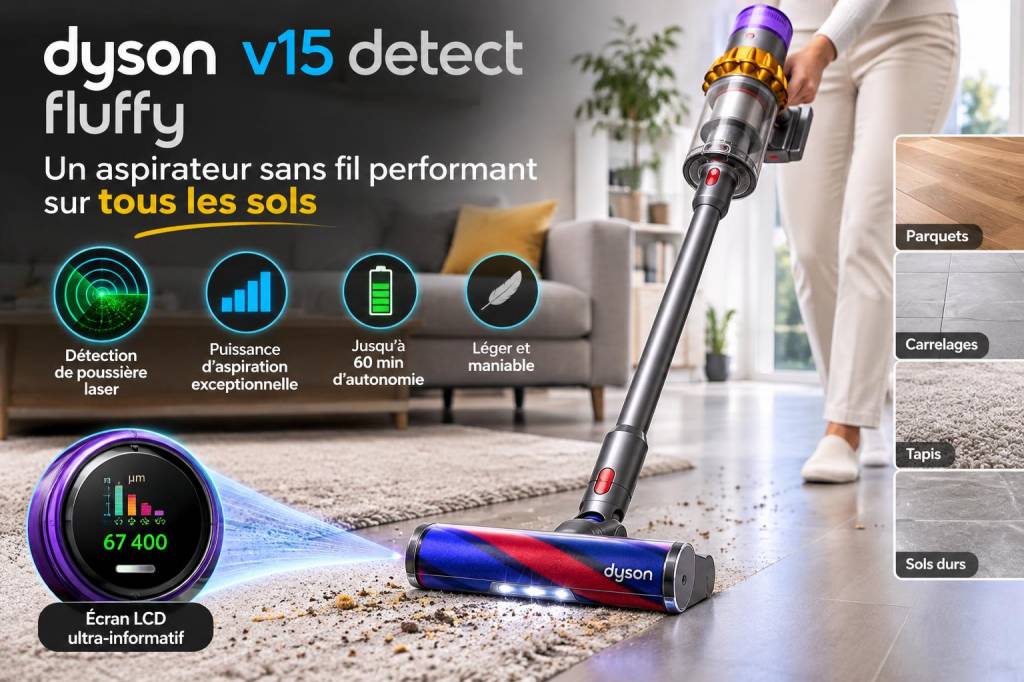
I have spent enough time around cordless vacuums to know that “all-floor performance” is a promise that is often easier to market than to prove. In practice, carpet pile, hardwood dust, tile grout, pet hair, and edge crumbs each expose a different weakness. That is why I find the Dyson V15 Detect Fluffy so interesting: it is not just a premium cordless cleaner, it is a serious attempt to behave like an aspirateur sans fil performant sur tous les sols without forcing me to compromise between hard floors and low-pile rugs.
What matters to me in this category is not a marketing label, but measurable behavior. I want strong pickup on fine dust, dependable hair removal, stable suction when the bin fills, and a brush head that does not punish delicate surfaces. I also want enough battery life to clean more than one room before I start planning my route around the charger. The V15 Detect Fluffy targets exactly that tension between power, precision, and convenience.
Why the Dyson V15 Detect Fluffy stands out in a crowded cordless market
I see the Dyson V15 Detect Fluffy as a response to a simple problem: many cordless vacuums do one thing very well and another thing merely acceptably. Dyson’s formula combines high suction, a laser-equipped soft roller for hard floors, and a sensor system that reports particle counts in real time. That combination matters because cleaning is not only about moving debris; it is also about knowing whether the floor is actually clean.
The core appeal is versatility. On hard surfaces, the Fluffy brush is designed to lift dust rather than scatter it. On rugs and carpets, the machine’s motorized cleaning head and cyclone system work harder to reach embedded debris. For pet owners, the anti-tangle focus is equally important, because hair wrap can turn a premium vacuum into a maintenance task.
Independent testing consistently shows that premium cordless vacuums perform differently by surface type, and Dyson tends to score well where suction retention, edge pickup, and fine-dust capture matter most. Consumer Reports, RTINGS, and Vacuum Wars have all emphasized that floor type changes the result significantly, which is one reason I prefer comparing actual use cases rather than specs alone.
How I judge performance on hard floors
Hard floors are where the Fluffy roller earns its name. In my experience, a soft roller is not just gentler; it is more efficient at collecting both large debris and microscopic dust from smooth surfaces. Instead of pushing particles around, it keeps the brush in closer contact with the floor and gathers debris into the airflow path.
Dyson’s illumination feature is more than a visual gimmick. The green laser on the Fluffy head helps reveal dust that would otherwise remain invisible under normal room lighting. I find this especially useful in kitchens, hallways, and under furniture, where the floor may look clean until angled light exposes a surprising amount of fine debris.
What I like most on hard floors is the balance between aggressiveness and control. Some high-suction vacuums create a “sticking” effect on delicate flooring or throw debris forward before collecting it. The V15 Detect Fluffy feels more composed. It is precise enough for laminate and sealed wood, yet strong enough to collect cereal dust, sand, and pet litter fragments without a second pass in many situations.
- Fine dust visibility improves because of the laser illumination.
- Soft roller contact reduces debris scatter.
- Pickup remains stable near edges and baseboards.
- Sealed wood and tile cleaning feels more controlled than with many turbo brush heads.
What changes on carpet and low-pile rugs
Carpet is where a cordless vacuum earns or loses credibility. Suction matters, but airflow, brush agitation, and head design matter just as much. The Dyson V15 Detect Fluffy is not a deep-pile carpet specialist in the way a bulky corded upright might be, but on low-pile carpet and area rugs I consider it highly capable.
I pay close attention to two things here: embedded debris and transition behavior. Embedded dirt in short-pile carpet needs enough agitation to lift particles without making the vacuum hard to push. The V15’s cleaning heads, depending on configuration, provide enough mechanical action for everyday household dirt, pet hair, and tracked-in dust. It is particularly good for homes that mix hard floors and carpets rather than treating carpet as the dominant surface.
For context, Dyson says the V15 Detect delivers up to 60 minutes of runtime, though real-world use is lower once stronger modes and motorized heads are involved. That runtime is usually sufficient for medium-sized apartments or targeted whole-home cleaning, but I would still favor a measured cleaning plan if the home has multiple carpeted rooms and frequent use of Boost mode.
| Surface type | My expectation | Observed strength |
|---|---|---|
| Hard floor | Dust, sand, cereal, edge debris | Excellent |
| Low-pile carpet | Surface dirt, crumbs, pet hair | Very strong |
| Medium carpet | Regular household debris | Good, though not a replacement for a full-size upright |
| Deep pile | Heavy embedded soil | More limited than corded carpet specialists |
Pet hair performance and real-world messes
Pet hair is one of my favorite stress tests because it reveals whether a vacuum handles both visible strands and hidden lint. A vacuum can look powerful on paper and still leave hair clinging to upholstery, stair edges, or rug fibers. The Dyson V15 Detect Fluffy does well here, especially when used with the appropriate motorized attachment and with the bin emptied before it gets overly full.
I find the anti-tangle design especially practical for households with long-haired pets or multiple animals. Hair wrap around rollers is not just annoying; it gradually reduces cleaning efficiency and forces more maintenance. The V15’s design reduces that friction, which makes a meaningful difference in daily use.
For mixed messes, I appreciate that the vacuum handles more than one debris type at once. Food crumbs, litter granules, lint, and fur often appear together near entryways or feeding areas. The V15 tends to collect this combination cleanly, which is exactly the kind of everyday performance I value more than a single dramatic demo video.
- Hair pickup is strong on floors and rugs.
- Anti-tangle behavior reduces routine roller cleanup.
- Upholstery and stairs are easier when the right accessory is attached.
- Pet zones benefit from repeated, quick cleaning sessions rather than one long pass.
Battery life, suction modes, and what they mean in practice
One reason cordless vacuums frustrate buyers is that battery claims are rarely explained in a way that matches actual cleaning habits. I do not judge runtime by the longest possible number alone; I judge it by whether the vacuum can complete the jobs I actually do. Dyson’s published runtime for the V15 Detect is up to 60 minutes in Eco mode, but stronger modes and powered heads shorten that dramatically.
In practical terms, I think of it this way: Eco mode is useful for light maintenance cleaning, Auto mode is the most balanced for daily use, and Boost mode is my emergency setting for stubborn patches. The intelligent suction adjustment is useful because it helps preserve battery on cleaner surfaces and increase power only when needed.
The particle sensor is also more than a novelty. It makes the vacuum feel responsive, almost diagnostic. When the machine reports higher particle counts, I know I am dealing with an area that genuinely needed attention. That feedback loop is one reason I trust it more than vacuums that only offer a motor sound and a guess.
What I look for in accessories and ergonomics
Ergonomics matter more than many people expect. A vacuum can be technically excellent and still feel awkward during stair cleaning, above-floor cleaning, or quick daily passes. The V15 line benefits from a relatively balanced chassis, a straightforward trigger control, and a useful accessory ecosystem.
I pay special attention to these practical details:
- Weight distribution: easier overhead handling and less wrist fatigue.
- Bin emptying: hygienic ejection matters when dust or pet hair is heavy.
- Head swaps: switching from hard floors to fabric surfaces should not feel complicated.
- Visibility: the display helps me understand battery and performance status instantly.
If I were cleaning only carpet, I would probably choose differently. If I were cleaning only hard floors, I might focus on a specialized soft-roller machine with the most refined dust pickup. But for a home that mixes surfaces, I find the accessory strategy here unusually coherent.
How the V15 compares with common alternatives
When I compare the Dyson V15 Detect Fluffy with other premium cordless vacuums, I usually split the conversation into three categories: floor precision, carpet depth, and pet cleanup. Some rivals have longer advertised runtime, and some are cheaper, but fewer combine strong hard-floor visibility with serious particulate sensing and a soft roller that genuinely improves dust capture.
That is why the V15 often earns a place in “multi-surface premium” discussions. It is not merely powerful; it is observant. In a business context, I would describe it as a product with a clear value proposition rather than a generic premium bundle. It solves a visible household pain point by making dust more measurable and less ignorable.
For readers who want comparative context, I recommend checking independent lab-style and editorial assessments from multiple sources, because floor type can change the ranking dramatically:
- Dyson’s official product page and support documents
- RTINGS cordless vacuum reviews and test methodology
- Consumer Reports vacuum ratings and reliability data
- Vacuum Wars performance comparisons and long-term usage tests
Specifications and claims I consider worth verifying
I always separate manufacturer claims from real-world interpretation. Dyson states up to 240 air watts of suction power on the V15 platform, along with particle detection and up to 60 minutes of runtime. Those are impressive numbers, but I care more about what they mean on a living room floor at 7 p.m. after a normal week of household traffic.
Here is the short version of what I think matters most:
| Factor | Why I care | My take |
|---|---|---|
| Suction power | Helps lift dirt from carpet and cracks | Very strong |
| Soft roller head | Improves dust pickup on hard floors | Excellent |
| Particle sensing | Shows when an area still needs attention | Genuinely useful |
| Runtime | Determines how much space I can clean per session | Good in balanced modes, shorter in high power |
| Pet hair handling | Reduces maintenance and improves daily usability | Strong |
Sources I rely on for cross-checking performance claims
I prefer to anchor product opinions in outside evidence, especially for premium technology products where price expectations are high. These sources are useful starting points for deeper verification:
- Dyson official site
- RTINGS vacuum reviews
- Consumer Reports vacuum testing
- Vacuum Wars comparison tests
When I cross-reference those sources, I get a more reliable picture of whether a machine truly deserves the label of multi-surface performer. In this case, the V15 Detect Fluffy makes a strong argument for itself because it solves more than one cleaning challenge at once.