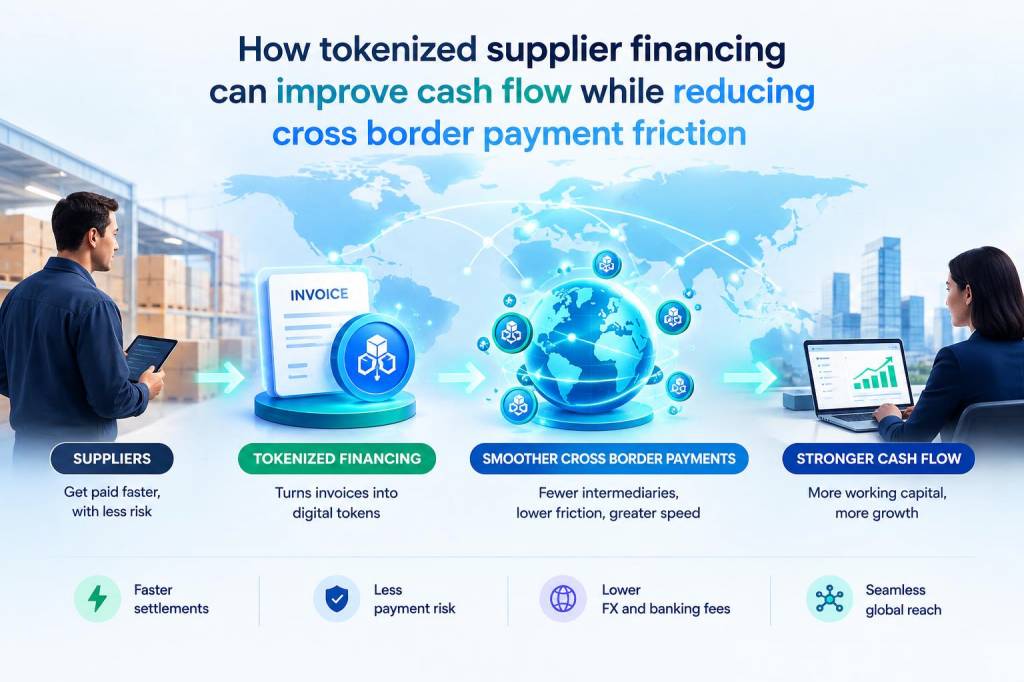
I have watched many finance teams wrestle with the same painful pattern: suppliers need faster access to cash, buyers want longer payment terms, and cross-border transfers add cost, delay, and uncertainty at every step. Tokenized supplier financing changes that dynamic by turning an invoice, a receivable, or a financing claim into a digital asset that can be transferred, funded, and settled with far less friction than traditional rails usually allow. In practical terms, that means more liquidity for suppliers, more working capital flexibility for buyers, and fewer of the operational headaches that often come with international payments.
What makes this model interesting to me is not just the technology itself, but the way it connects two needs that often seem to be in tension. Suppliers want cash now. Finance teams want control, visibility, and predictable terms. Tokenization can help bridge that gap by representing a financial claim on-chain, enabling faster transfer of value, easier fractional participation, and cleaner audit trails. When done well, it can reduce settlement delays, improve transparency, and make cross-border commerce feel much less like a patchwork of manual exceptions.
Why supplier financing still hurts in global trade
In many international supply chains, payment friction comes from a mix of bank cut-off times, correspondent banking layers, foreign exchange timing, compliance checks, and document mismatches. Even when a buyer is strong and reliable, a supplier may still wait days or weeks to receive payment because cash has to move through multiple intermediaries. That delay can force suppliers to borrow at higher rates, stretch their own payables, or absorb working capital stress that weakens the whole chain.
I see this especially in markets where smaller suppliers serve larger enterprises across borders. A large buyer may have excellent credit, but the supplier’s access to affordable financing is still limited by geography, currency, and local banking infrastructure. Traditional supply chain finance programs can help, yet they often remain centralized, operationally heavy, and difficult to extend across multiple jurisdictions. Tokenized financing offers a way to simplify access while preserving the credit quality tied to the underlying buyer relationship.
How tokenization changes receivables financing
At a basic level, tokenization means converting a real-world financial claim into a digital token that can be tracked and transferred on a blockchain or other distributed ledger. In supplier financing, that claim might represent an approved invoice, a future payment obligation, or a portion of a receivable funded by a third party. Once tokenized, the asset can be financed more efficiently because its status, ownership, and settlement history are easier to verify.
What I find most powerful is the possibility of near-real-time visibility. Instead of waiting for paper trails, emailed approvals, or delayed banking confirmations, parties can view a shared source of truth. That shared visibility can reduce disputes, speed up reconciliation, and lower the operational burden on treasury, procurement, and accounts payable teams. For suppliers, that can translate into faster access to working capital without forcing them into expensive short-term debt.
Tokenized supplier financing can take several forms:
- Invoice tokenization, where an approved invoice becomes a digital asset that can be financed or sold.
- Receivable tokenization, where future payment rights are represented as transferable units.
- Programmatic settlement structures, where smart contracts release funds when agreed conditions are met.
- Fractional participation, where multiple funders can support a single trade finance transaction.
Cash flow benefits for suppliers and buyers
For suppliers, the most immediate advantage is earlier access to cash. Instead of waiting for net-30, net-60, or net-90 terms to mature, a supplier can receive early payment from a funding source that trusts the buyer’s credit profile. That matters because supplier cash flow is often more important than headline revenue. A profitable supplier can still struggle if cash is locked inside receivables.
For buyers, the benefit is often more subtle but equally important. Buyers can preserve or extend payment terms without damaging supplier relationships. If the financing structure is transparent and reliable, suppliers may even prefer it because they gain predictability. In my view, that is one of the strongest arguments for tokenized supplier financing: it can support both sides of the relationship instead of forcing one party to absorb all the pressure.
There is also a portfolio benefit for finance providers. A tokenized asset can be subdivided, traded, or pooled with more efficiency than a traditional paper-based claim. That can broaden participation from banks, funds, fintech platforms, and even corporate treasuries looking for short-duration yield linked to real commercial activity. More participants can mean deeper liquidity, which can improve pricing for suppliers and buyers alike.
Where cross-border payment friction gets reduced
Cross-border settlement usually suffers from a combination of slow messaging, fragmented banking networks, and unclear cut-off times. Tokenized settlement can reduce that friction in several ways. First, it can shorten the path between funding approval and disbursement. Second, it can create a more direct link between the financed invoice and the payment event. Third, it can reduce the number of manual reconciliations needed across time zones, currencies, and intermediaries.
When a tokenized financing workflow is connected to stable settlement infrastructure, the experience can feel dramatically smoother. A supplier in one country can receive value more quickly, while the buyer’s treasury team retains control over payment conditions. If foreign exchange is built into the workflow, conversion can happen closer to the time of settlement rather than days earlier, reducing exposure to currency swings. That is especially useful for businesses operating in regions where volatility can change the economics of a transaction overnight.
Another overlooked benefit is documentation. International trade often requires invoices, purchase orders, shipment confirmations, and compliance checks. A tokenized structure can embed references to these records and reduce the chance that one party is working from an outdated version. That does not eliminate compliance obligations, but it can make them more manageable and easier to audit.
What has to be true for it work
I would not pretend tokenized supplier financing is effortless. It works only when legal, technical, and operational pieces fit together. The token must map clearly to an enforceable real-world claim. The platform must handle identity, sanctions screening, and fraud prevention. The financing terms must be transparent enough that all parties understand exactly what is happening when a token moves or settles.
There are also questions about custody, access, and regulatory treatment. In some markets, a tokenized receivable may be treated differently from a conventional invoice assignment. That means legal review is not optional. I always think the strongest implementations are the ones where blockchain is not treated as a magic layer, but as a coordination tool sitting on top of robust commercial and legal structures.
From a technology perspective, integration matters more than hype. A system that cannot connect to ERP platforms, treasury tools, and compliance engines will quickly become a silo. The most effective programs are usually the ones that meet finance teams where they already work, then gradually automate the manual steps that create delay and error.
| Dimension | Traditional Supplier Financing | Tokenized Supplier Financing |
|---|---|---|
| Settlement speed | Often slow, with multiple intermediaries | Potentially faster with direct digital settlement |
| Visibility | Fragmented across systems and parties | Shared ledger can improve transparency |
| Cross-border friction | Higher due to banking layers and FX timing | Lower when settlement and records are coordinated |
| Access to liquidity | Often limited by geography and bank relationships | Can broaden funder participation |
| Reconciliation | Manual and time-consuming | More automated with digital records |
Where I see real business value emerging
From a business standpoint, tokenized supplier financing becomes compelling when it improves both margin and resilience. Lower financing friction can improve supplier stability, which in turn supports continuity of supply. For buyers, that means fewer disruptions, stronger relationships, and better negotiating leverage that comes from being a reliable counterparty rather than a difficult one.
I also see value in sectors with complex, global supply chains: manufacturing, electronics, consumer goods, commodities, and logistics. In these environments, even small delays can ripple through entire production networks. If tokenized financing can reduce days sales outstanding for suppliers while preserving buyer working capital, it can create a measurable competitive edge.
For financial institutions and fintech platforms, there is an opportunity to build products around asset-backed digital liquidity. Rather than funding abstract speculation, they can support real commerce with clearer data and better risk controls. That can appeal to institutions that want exposure to short-dated, trade-linked assets without relying on legacy workflows that are expensive to scale.
Questions I hear most often about this model
People usually ask whether tokenization replaces banks. I do not think that is the right frame. In many cases, banks remain essential for funding, compliance, foreign exchange, and client relationships. Tokenization is more likely to reshape how those services are delivered than to eliminate them.
Others ask whether this is only useful for large enterprises. My answer is no, although scale helps. Smaller suppliers may benefit even more because they are often the ones most constrained by slow cash conversion cycles. The challenge is making the onboarding process simple enough that the technology does not become another barrier.
A final question is whether blockchain is required. Strictly speaking, some form of digital ledger or token registry is needed, but the real business question is not whether a chain exists. It is whether the system creates trust, speed, and interoperability without introducing new operational risk. If it does, then the underlying infrastructure has earned its place.
In practice, I believe tokenized supplier financing will gain momentum where companies are already under pressure to improve working capital, reduce cross-border complexity, and modernize treasury operations. That makes it less of a crypto novelty and more of a serious commercial tool, especially when linked to stable payment infrastructure, disciplined credit underwriting, and clear legal enforceability. When those pieces align, the result can be a financing model that feels faster, cleaner, and far more adaptable to global trade than many of the systems businesses still rely on today.