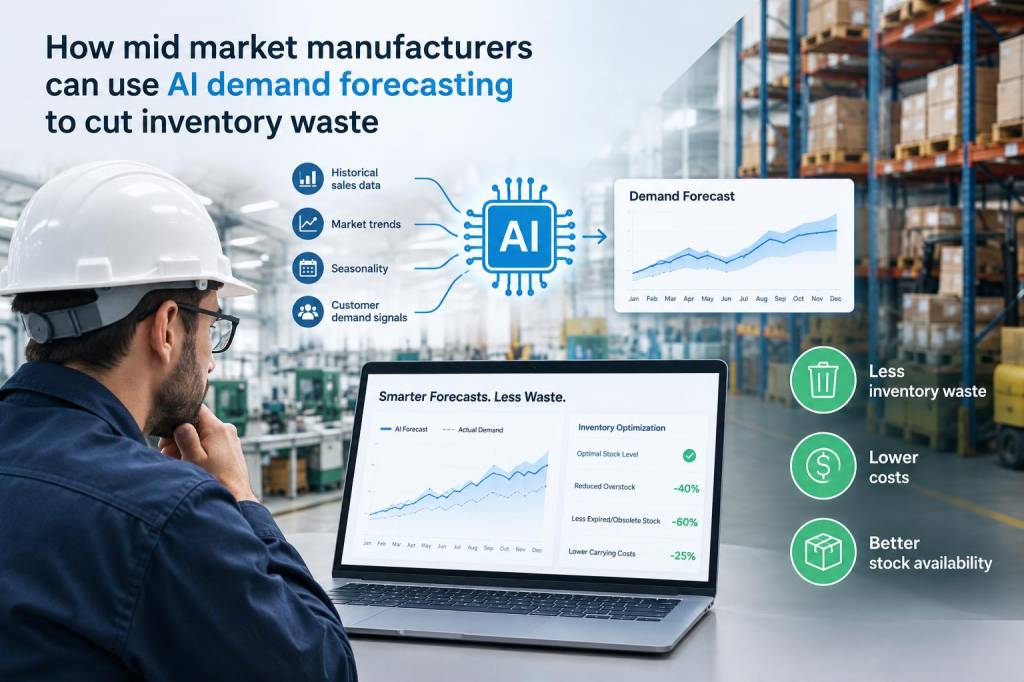
I have seen many mid-market manufacturers struggle with a familiar problem: too much cash tied up in stock, too many slow-moving materials sitting on shelves, and too many urgent decisions made after demand has already shifted. In my experience, inventory waste rarely comes from one dramatic mistake. It usually comes from small forecasting errors repeated over and over until they become expensive. That is why I believe AI demand forecasting is becoming one of the most practical tools available for manufacturers that want to reduce waste without sacrificing service levels.
What makes this especially relevant for mid-market firms is scale. Large enterprises often have entire planning teams, advanced data teams, and complex planning systems. Smaller manufacturers may rely on instinct, spreadsheets, or a single planner who knows the business very well. Mid-market manufacturers sit in between. They are large enough to feel the pain of bad forecasts, but not always large enough to absorb the cost of excess inventory. AI can help close that gap in a way that feels realistic, not futuristic.
Why inventory waste becomes so expensive
Inventory waste is not only about expired raw materials or obsolete finished goods. It also includes excess storage costs, unnecessary handling, repeated production changes, discounting, rushed shipments, and lost opportunity when capital is trapped in stock that is not moving. I have noticed that many manufacturers underestimate the full impact because the damage appears across several departments instead of one single line item.
When demand is volatile, planning teams often hedge by ordering more than necessary. That can feel safe in the short term, yet it creates a chain reaction:
AI forecasting matters because it does more than predict sales volume. It can detect patterns in seasonality, customer behavior, lead times, promotions, weather effects, regional differences, and even macroeconomic signals. That broader view helps planners make decisions with more confidence and less guesswork.
What AI forecasting does differently
Traditional forecasting usually depends on historical averages, linear trends, and manual adjustments. Those methods can still work in stable markets, but manufacturing rarely stays stable for long. A single customer delay, a sudden promotion, a raw material issue, or a shift in channel demand can distort assumptions very quickly.
AI systems learn from many variables at once. They can identify relationships that are hard to spot manually, especially when those relationships change over time. For example, an AI model may notice that one product line sells more strongly when a certain distributor increases digital advertising, or that demand drops when lead times rise beyond a specific threshold. A planner may eventually see the same pattern, but AI can surface it earlier and at greater scale.
In practice, this means forecasts become more responsive. Instead of relying on a single monthly number, teams can work with rolling forecasts that update as new data arrives. That makes it easier to adjust production plans, raw material purchases, and safety stock levels before waste builds up.
Data quality matters more than model complexity
One mistake I often see is assuming that AI will fix weak data automatically. It will not. If sales orders are incomplete, if item codes are inconsistent, or if inventory movements are recorded poorly, even a strong model will produce weak output. For manufacturers, the starting point is usually not advanced modeling. It is clean operational data.
I recommend focusing on a few essential data sources first:
Once those inputs are reliable, AI can begin to add real value. In my view, this is where many firms underestimate the opportunity. They expect a dramatic transformation from day one, when in reality the first gains often come from simply connecting data that was already there but not being used together.
Where mid-market manufacturers see waste reduction first
Not every product category benefits in the same way. Some inventory items are highly predictable, while others are more volatile. AI tends to create the fastest wins in areas where demand fluctuates enough to create planning uncertainty.
Common areas of impact include:
I have found that many manufacturers begin by applying AI forecasting to a limited product family rather than the entire catalog. That approach is smart. It reduces implementation risk and gives the team a chance to compare AI-driven forecasts against current methods. If the results are strong, the model can expand gradually.
How I would approach implementation in a practical way
If I were advising a mid-market manufacturer starting from scratch, I would avoid a big-bang rollout. I would begin with a focused pilot that addresses a painful but manageable problem. The goal would be to prove that the model can reduce overstock, improve service, or cut write-offs within a specific category.
A practical rollout usually follows this path:
That kind of disciplined approach matters because AI is not only a software purchase. It is a change in planning behavior. Teams need time to trust the recommendations, understand the exceptions, and build confidence in the new process.
The human role still matters a lot
I do not believe AI should replace experienced planners. In manufacturing, local knowledge still matters. A planner may know that a customer is likely to place a large order before a contract renews, or that a particular product has hidden demand because of a regional distributor relationship. AI can miss those nuances unless someone captures them and feeds them into the planning process.
What I like most about AI forecasting is that it can support better human judgment. It gives planners a stronger baseline, highlights unusual changes, and frees them from some of the repetitive work of manual reforecasting. That leaves more time for exception handling, supplier coordination, and scenario planning.
In many organizations, the best results come from combining machine insight with human review. The system proposes a forecast, and the team validates it against business context. That partnership is often far more effective than either approach alone.
Questions I hear most often from manufacturers
Will AI forecasting work if our data is messy? It can still help, but the value will be limited until core data is improved. A pilot can reveal the biggest gaps quickly.
Do we need a large analytics team? Not necessarily. Many mid-market firms start with a small internal team and a vendor or implementation partner. What matters more is operational ownership and a willingness to refine processes.
Can AI forecast products with irregular demand? Yes, often better than traditional methods. Irregular patterns are exactly where many standard forecasting tools struggle.
How soon can waste be reduced? In some cases, improvements appear within one planning cycle. In others, the benefits build gradually as the model learns and the team adjusts inventory policies.
A simple comparison of traditional planning and AI-assisted planning
| Planning Area | Traditional Approach | AI-Assisted Approach |
|---|---|---|
| Demand estimate | Historical average and manual edits | Pattern-based forecast using multiple variables |
| Reaction to change | Delayed review after problems appear | Continuous updates as new data arrives |
| Inventory policy | Broad safety stock assumptions | More precise stock levels by item and channel |
| Planner workload | Heavy manual correction | More time for exceptions and decisions |
| Waste risk | Higher in volatile categories | Lower when forecasts improve and inventory is aligned |
What success looks like in real operations
When AI forecasting is working well, I usually expect to see several signs. Forecast error begins to narrow in important product groups. Overstock declines in categories that were previously hard to manage. Planners spend less time correcting the same mistakes each month. Service levels remain stable even as inventory drops. Most important, leadership starts to make decisions with more confidence because the numbers are less reactive and more connected to actual demand behavior.
There is also a cultural benefit. Once teams see that better forecasting can reduce waste without hurting customer service, planning discussions become more strategic. Instead of asking only, “How much should we buy?”, the team starts asking, “What signal is driving demand?”, “Where is risk concentrated?”, and “Which products deserve closer monitoring?” That shift in thinking can change the entire planning function.
I believe that is why AI demand forecasting has become so relevant for mid-market manufacturers. It is not just a technology story. It is a practical way to use data more intelligently, reduce avoidable inventory waste, and make every production and purchasing decision feel a little less like a guess and a little more like a well-informed move.