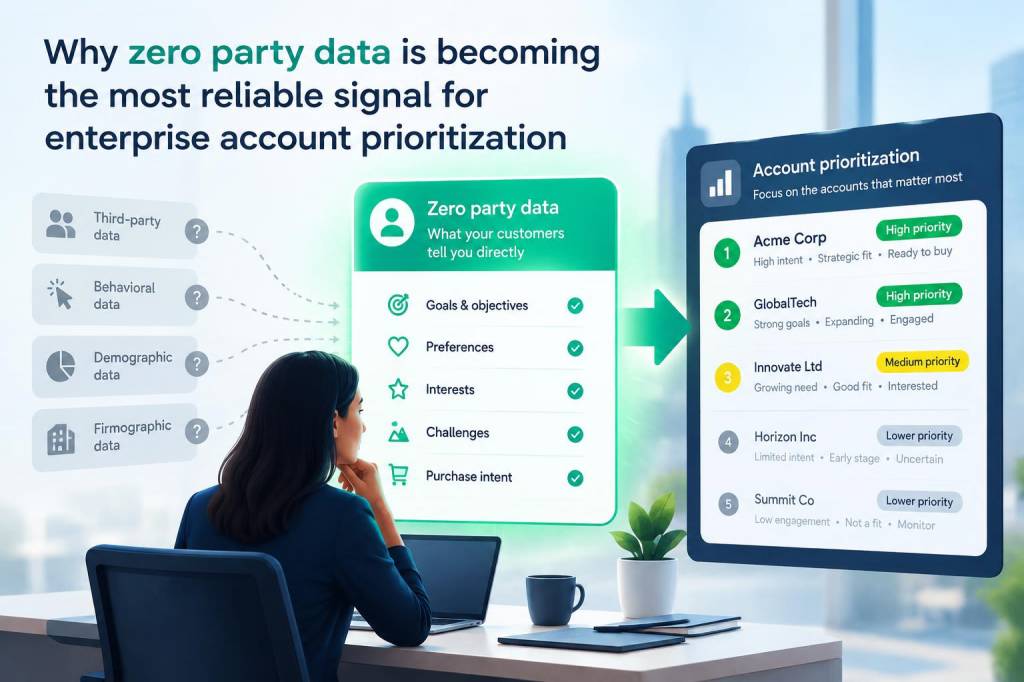
I have seen a major shift in account prioritization over the last few years, and it has changed the way I think about sales and marketing alignment. In many enterprise teams, intent data, firmographic scoring, and behavioral signals still matter, but zero-party data is becoming the signal I trust most when deciding which accounts deserve immediate attention. That is because zero-party data comes directly from the buyer, in their own words, with clear context about needs, timing, goals, and preferences. It removes much of the guesswork that usually surrounds enterprise buying behavior.
What makes this especially valuable is simple: enterprise buying is messy. A large account may look perfect on paper, generate strong website engagement, and still be nowhere near a purchase decision. Another account may appear quiet in public channels while quietly revealing high urgency through a survey, preference center, webinar form, or product assessment. When I compare those two situations, zero-party data usually gives me a clearer signal about real priority than any passive tracking method ever could.
Why direct buyer input matters so much
Traditional prioritization models often depend on inferred behavior. I can see page visits, email clicks, LinkedIn engagement, or third-party intent activity, and those signals can be useful. Still, they are indirect. They tell me what someone did, but not always why they did it. Zero-party data changes that by asking people to tell us what matters to them.
When an enterprise prospect shares budget range, project timeline, pain points, internal buying role, or technical requirements, I gain something much more powerful than a behavioral guess. I get stated intent. That kind of signal is harder to misread because it comes from an explicit conversation rather than an algorithmic assumption.
I also find that zero-party data tends to be more current. Enterprise accounts evolve quickly. A company that was not ready three months ago may now be facing a compliance deadline, leadership change, merger integration, or technology replacement cycle. If I rely only on historical engagement, I may miss that shift. If I collect zero-party data through regular touchpoints, I can detect change much earlier.
What makes zero-party data more reliable than other signals
Reliability in account prioritization is not only about accuracy. It is about confidence. I want to know whether an account is worth outreach, whether it should be routed to sales, and whether it deserves custom messaging or a broader nurture path. Zero-party data helps because it reduces ambiguity.
Here is why I consider it so dependable:
- It reflects self-reported need rather than inferred interest.
- It can reveal timing, which is often missing from other signals.
- It often includes preference data that improves outreach relevance.
- It helps separate curiosity from active evaluation.
- It gives context that supports better segmentation and routing.
I have also noticed that zero-party data tends to be richer when the interaction is designed well. A short assessment, a preference form, a live event registration, or a post-demo survey can produce surprisingly strong prioritization insight if the questions are thoughtful. The key is not volume. It is specificity.
Where I use zero-party data in enterprise prioritization
In practice, I use zero-party data at several points in the account journey. One of the most useful moments is early qualification. Instead of treating every form fill as equal, I look for answers that indicate urgency, scope, and business impact. If a prospect tells me they are evaluating a solution for a regional rollout, that account deserves a different level of attention from one that is merely exploring industry news.
I also find zero-party data useful after content engagement. For example, if someone downloads a report and then answers a short question about current priorities, I can immediately understand whether they are researching, comparing, or preparing to buy. That context helps me determine whether the account belongs in an executive outreach track, a technical validation track, or a long-term nurture sequence.
Another place where this signal is powerful is event marketing. I like using event registration forms, breakout-session selections, and post-event feedback to capture buyer needs. A person who chooses sessions related to implementation, data integration, or governance is often much closer to an enterprise purchase than someone who only attends a broad thought-leadership session.
Zero-party data and account scoring
One reason I value zero-party data so highly is that it improves account scoring models without creating false confidence. Too many scoring systems overvalue shallow engagement. A few opens or clicks can inflate an account score even when there is no real buying motion. Zero-party data helps correct that problem by adding explicit signals that can raise or lower priority with more confidence.
I often think of it as a calibration layer. Behavioral data tells me where an account is active. Firmographic data tells me whether an account fits. Zero-party data tells me whether an account is ready, why it matters, and what should happen next. That combination is far stronger than any single signal on its own.
For example, if an account matches my ideal customer profile but reports no current initiative, I may keep it warm rather than push for immediate sales outreach. On the other hand, if a mid-fit account reveals a serious migration project with a tight deadline, I may move it higher in priority than expected. That is the kind of nuance enterprise teams need, especially when resources are limited.
Why buyers are often willing to share more than people expect
Some marketers worry that asking for direct input will reduce conversion rates. I understand that concern, but in my experience, buyers are often willing to share useful information when the exchange is clear. People do not mind answering relevant questions if they believe it will improve their experience.
That is where trust becomes essential. If I ask for information and then ignore it, I damage credibility. If I ask for preferences and then send generic follow-up, I train buyers not to engage again. But when I use the information to provide better recommendations, more relevant content, or a faster path to the right contact, buyers usually respond positively.
This is especially true in enterprise environments, where buyers are used to complex evaluation cycles. They often appreciate being treated as informed professionals rather than anonymous traffic. Zero-party data supports that expectation because it signals respect for the buyer’s perspective.
Questions I ask to capture stronger prioritization data
When I design a form, survey, or conversational flow, I try to focus on questions that improve decision-making. I do not want fluff. I want answers that help me route, score, and personalize with confidence.
- What challenge is most urgent right now?
- What timeline is attached to this initiative?
- Which team owns the project?
- What outcome matters most to leadership?
- Which systems or processes are affected?
- What content format is most useful right now?
- What buying stage best reflects current progress?
These questions do more than gather data. They help me understand context. A timeline without urgency is weak. A pain point without business impact is incomplete. A preference without buying stage is useful, but not enough. The real value comes from combining these answers into a clearer picture of account readiness.
How zero-party data supports marketing and sales alignment
I have always believed that prioritization works better when marketing and sales share a common source of truth. Zero-party data helps create that alignment because both teams can interpret it directly. Instead of debating whether an account is truly engaged, both sides can review what the buyer actually said.
That shared visibility reduces friction. Marketing can use the data to tailor nurture streams and content journeys. Sales can use it to personalize outreach and sequence timing. Customer success can use it to anticipate adoption concerns or expansion opportunities. Everyone benefits from a clearer understanding of what the account needs.
In many organizations, alignment breaks down because each team relies on different assumptions. One team sees engagement volume, another sees pipeline stage, and another sees demographic fit. Zero-party data brings those views closer together by anchoring them in buyer expression. That makes prioritization less political and more practical.
Where zero-party data can fail if I am not careful
Even though I value this signal, I do not treat it as perfect. Like any data source, it can be incomplete, biased, or outdated. Someone may overstate urgency, share a generic answer, or provide information that reflects only one stakeholder view in a larger buying group. That is why I never use zero-party data alone.
I also watch for collection fatigue. If I ask too many questions too often, people stop responding honestly or abandon the process entirely. I prefer small, meaningful moments of input rather than long, repetitive forms. The best zero-party data is collected with intention and used with discipline.
Another risk is over-personalization without enough scale. It is easy to build rich experiences for a small number of accounts, but enterprise programs still need systems that can operate broadly. I use zero-party data as a priority signal and a context signal, not as a reason to create an unsustainable manual process.
A simple comparison of common account signals
| Signal type | What it shows | Strength | Weakness |
|---|---|---|---|
| Behavioral data | What people did | Useful for activity detection | Often lacks intent context |
| Firmographic data | Whether an account fits | Strong for qualification | Does not show timing or urgency |
| Third-party intent | Possible interest in a topic | Good for broad market signals | Can be noisy or indirect |
| Zero-party data | What buyers say directly | Clear context and stronger confidence | Requires thoughtful collection |
When I place these signals side by side, zero-party data stands out because it is the most explicit. It does not replace other data types, but it often tells me whether an account deserves immediate focus or can remain in a lower-priority path for now.
Why this signal is becoming more important now
I believe zero-party data is rising in importance because buyer journeys have become more fragmented. Privacy expectations are higher, third-party tracking is less dependable, and enterprise teams need a more honest picture of account readiness. In that environment, direct buyer input becomes not just helpful, but essential.
It also fits the direction of modern B2B marketing. Buyers expect relevance, speed, and respect for their time. Zero-party data helps deliver all three. It lets me avoid generic assumptions and focus on what matters to a specific account at a specific moment.
For me, that is why this signal keeps gaining ground in enterprise prioritization. It is not simply another data layer. It is a more trustworthy reflection of buyer intent, and when I use it well, it helps me place my energy where it can create the most value.