When I first tried to get a SaaS pilot approved by procurement and the CFO in 30 days, I quickly learned that persuasion alone wasn't enough. What wins approvals is a tight, evidence-backed dossier that answers every financial, security, and operational question before it’s asked. Over several pilots across marketing automation, CRM, and analytics tools, I refined a repeatable dossier template that gets sign-off fast. Below I share the exact structure, content, and timeline I use to turn a promising SaaS into a green-lit pilot within 30 days.
Why a pilot dossier matters (and what stakeholders actually want)
Procurement wants clarity on contracts, SLAs, and vendor viability. The CFO wants predictable costs, measurable ROI, and minimal risk. IT/security teams focus on data protection, architecture, and compliance. If your dossier doesn’t speak to each of those needs in plain language, you’ll get delays and endless follow-up questions.
I always start by mapping stakeholders and the primary question they need answered. This keeps the dossier focused and accelerates decision-making.
What to include in the pilot dossier
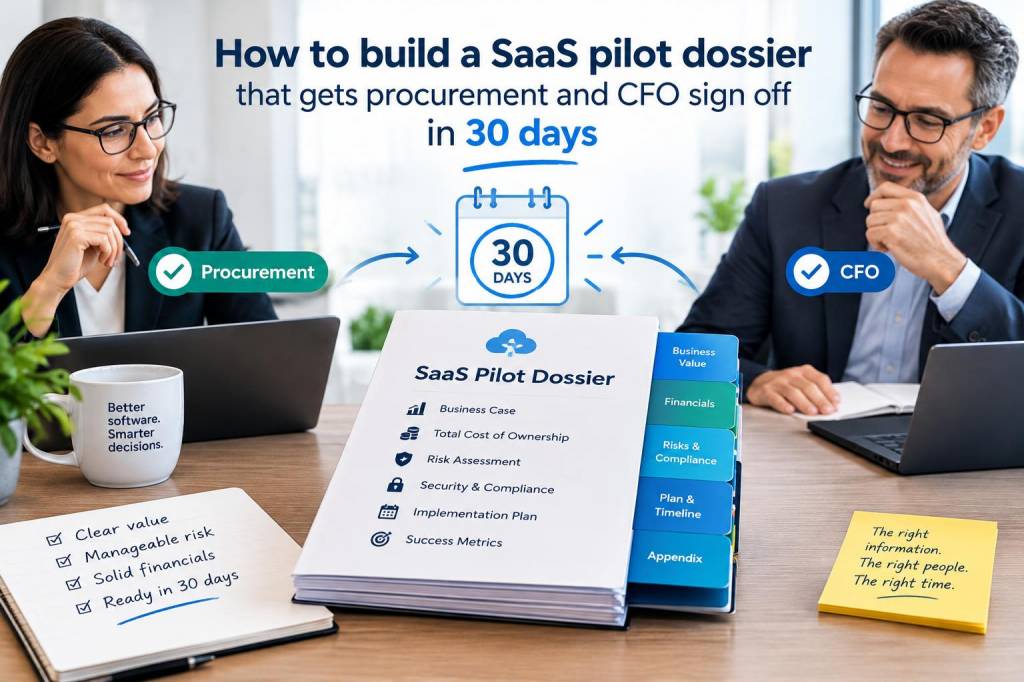
Your dossier should be concise (6–12 pages) and scannable. Use headings, a one-page executive summary, and tables for financials. Below are the must-have sections I never skip.
- Executive summary (one page): Purpose of the pilot, duration, primary KPI, pilot owner, brief vendor snapshot, and the expected business outcome.
- Business case & objectives: Describe the problem, how the SaaS solves it, and 2–3 measurable objectives (e.g., reduce lead-to-opportunity time by 20% in 60 days).
- Success metrics & measurement plan: Define primary and secondary KPIs, baseline metrics, data sources, reporting cadence, and who owns measurement.
- Financial summary: Pilot cost breakdown, total cost of ownership (TCO) if scaled, and a simple ROI model with sensitivity (best/worst case).
- Procurement & legal: Contract type (trial/PO/short-term), termination rights, IP considerations, and any standard redlines you expect.
- Security & compliance: Data flows, hosting region, encryption standards, SOC/ISO certifications, and a brief security test plan.
- Implementation plan & timeline: Roles, milestones for onboarding, integration points, and a 30-day Gantt-style view.
- Risks & mitigations: Top 5 risks with owner and mitigation actions (e.g., data migration failure → sandbox testing week 1).
- Vendor profile & references: Short vendor bio, funding, churn, key customers, and one quality reference who can validate delivery speed.
- Governance & exit strategy: Who signs off at pilot end, decision criteria, and steps to terminate or scale.
Executive summary: make it irresistible
Think of the executive summary as your one-page elevator pitch for executives who read quickly. I lead with the business impact and the single KPI we will move. For example: "Pilot to reduce MQL-to-SQL time by 25% in 60 days; 30-day pilot cost £6,000; expected 6x ROI within 12 months if scaled." Include a one-line ask: e.g., "Approval sought for a 30-day pilot with a fixed-price onboarding of £2,000 and monthly pilot license of £1,000."
Financials: be transparent and simple
CFOs want numbers laid out clearly. Use a small table to summarise costs and a tiny ROI model. Here's the table format I use:
| Line item | One-time (£) | Monthly (£) | Notes |
|---|---|---|---|
| Onboarding & integration | 2,000 | - | Fixed-price; includes 8 hours integration |
| Pilot licenses (5 users) | - | 1,000 | Vendor quote for pilot |
| Internal resource time (est.) | - | 500 | Project owner + IT support allocation |
| Total (30 days) | 2,000 | 1,500 |
Then follow with a simple ROI statement: "If pilot yields an incremental £12,000 in attributable pipeline within 6 months, payback is achieved and 6x ROI is possible if scaled." Keep assumptions explicit so the CFO can tweak them.
Security & compliance: be specific
Generic statements like "vendor is secure" don't work. Provide concrete answers:
- Data residency: UK/EU only?
- Certifications: SOC 2 Type II, ISO 27001?
- Encryption: at rest and in transit?
- Access control: SSO, MFA?
- Third-party subprocessors and data flows?
I attach a one-page security checklist (completed by the vendor) and flag any items needing IT sign-off. If the vendor lacks a certification, propose compensating controls (e.g., restricted dataset, pseudonymisation).
Implementation timeline: the 30-day plan
Time is the enemy of approvals. I put together a day-by-day plan that shows vendor and internal tasks. Example milestones:
- Day 1–3: Kick-off, sandbox access, SSO setup
- Day 4–10: Data connector build / sample sync
- Day 11–18: User training + scenarios
- Day 19–25: Live testing, KPI measurement baseline
- Day 26–30: Final review, decision & next steps
By breaking the work into short, measurable sprints, procurement and IT can see the pilot won’t balloon in complexity.
Mitigating procurement and legal concerns
Procurement often stalls on contract length and liability. In the dossier I propose a short, fixed-term agreement with a clear termination clause and limited liability for the company. If the vendor insists on a longer-term commitment, I negotiate a pilot-specific agreement or a clause that converts to a paid contract only with explicit executive sign-off.
Include a simple checklist for legal that lists acceptable answers (e.g., "No automatic renewal after pilot" = Yes/No). This speeds up contract review.
Governance and decision criteria
End the dossier with a governance table that names the decision-makers, their acceptance criteria, and the format of the final deliverable (dashboard, demo, or signed metrics). For example:
- Procurement: contract review complete, insurance validated
- IT/Security: SOC 2 or compensating controls approved
- CFO: TCO and ROI assumptions validated
- Pilot Owner (me): KPI hit rate >= 70% of target
If all boxes are ticked, the default next step is scaling. If not, the exit playbook must be clear: data deletion, account closure, and a short retro.
Operational tips that shave days off approval
From experience, these practical moves shorten reviews:
- Pre-vet vendors with procurement before drafting the dossier. If procurement already trusts the vendor, approvals are faster.
- Use vendor-provided templates for security and pricing to avoid back-and-forth.
- Offer to run a controlled data subset to satisfy security concerns quickly.
- Schedule a 30-minute stakeholder walk-through of the dossier—people approve what they understand.
- Be transparent with assumptions so CFOs can adjust models rather than reopen the whole case.
When I present a pilot dossier built this way, I rarely wait more than 48–72 hours for feedback from procurement or finance. The clarity and brevity create confidence—and in business, confidence accelerates action.