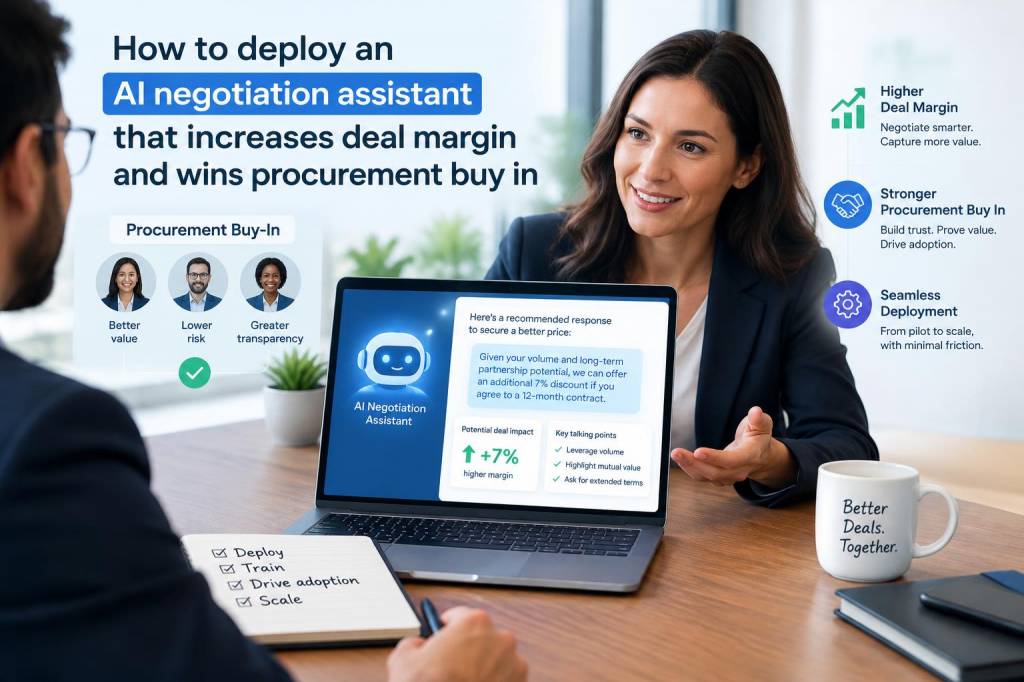
When I first piloted an AI negotiation assistant in a mid-sized manufacturing company, I was skeptical. Could a model really help sales teams protect margins while keeping procurement happy? The results surprised me: not only did deal margins improve, but procurement began to see the assistant as a partner, not a threat. If you're considering the same journey, here’s a practical, first-person playbook based on what worked — and what I learned the hard way.
Why an AI negotiation assistant — and what problem does it solve?
For me, the promise of an AI negotiation assistant was always straightforward: provide real-time guidance to sales reps during negotiations to protect margin, suggest concessions that preserve strategic value, and accelerate deal cycles. But beyond that, the real challenge is aligning this capability with procurement teams who often control the flow of RFPs and purchase terms.
In practice, the assistant should do three things well:
Start with a business case that speaks both to Sales and Procurement
I always begin with numbers. Procurement teams respond to risk, compliance, and total cost of ownership. Sales teams respond to quota and margin. Your business case should address both. Here’s how I framed it:
Include concrete KPIs — margin improvement, cycle time reduction, dispute rate — and show a 12-month ROI. When I presented a conservative case (3–5% margin lift on targeted segments), procurement focused on the process benefits and agreed to a pilot.
Design the assistant around human workflows
One mistake I've seen is building tech-first and people-second. Instead, map actual negotiation workflows. Where are the decision points? When does a seller escalate? What approvals does procurement require? I documented the following for the pilot:
The assistant needs to plug into the tools reps use (CRM, email, contract management) and surface guidance without disrupting flow. For us, integrating with Salesforce and our contract repository was non-negotiable.
Choose the right tech stack and integrations
I recommend a modular approach: base model + domain adapters + integrations. For natural language and real-time guidance, Large Language Models (LLMs) like OpenAI's GPT family or Anthropic's Claude work well, but you must fine-tune or use retrieval-augmented generation (RAG) with your pricing rules and contract library.
Key components I used:
Security matters: ensure data residency, API access controls, and human review workflows to prevent the model from suggesting non-compliant terms. Procurement insisted on an “approval required” flag for any deviation outside guardrails — a small governance step that built trust.
Train the assistant on your language and playbooks
Out-of-the-box models don’t know your playbooks. I fed the assistant examples: past negotiations, annotated with what worked and why. The training data included:
We created prompts that surfaced multiple options — a conservative counteroffer, a strategic concession tied to volume, and a creative bundle alternative — each with predicted margin impact and risk score. Reps loved having options rather than a single “answer.”
Pilot with a cross-functional cohort
Choose a small but representative cohort: three sales reps, two procurement leads, and one legal reviewer. Run live pilots on low-to-medium risk deals. I insisted on a “human-in-the-loop” approach where reps could accept, modify, or reject the assistant’s suggestions.
During the pilot, collect qualitative feedback:
Use these insights to refine prompts, adjust pricing guardrails, and reduce false positives in risk flags.
Measure the right KPIs
We tracked a mix of financial, operational, and adoption metrics. Here are the ones that mattered most to stakeholders:
| KPI | Baseline | Target (6 months) |
| Average deal margin | 15% | 18% (+3 pts) |
| Time to close | 45 days | 30 days |
| Procurement escalations | 10% of deals | 5% |
| Assistant adoption rate | 0% | 70% of target cohort |
After three months, we already saw margin creep upward and a sharp drop in unnecessary escalation. Those numbers made it easy to get budget for broader rollout.
Drive procurement buy-in through transparency and control
Procurement fears loss of control and hidden concessions. Address that head-on:
We also created a “Procurement Review Queue” where the assistant flagged deals that matched risk patterns; procurement could triage these quickly. This shifted procurement from policing to partnership.
Change management is as important as the model
My biggest non-technical lesson: adoption hinges on training, storytelling, and rewards. I ran weekly role-play sessions where reps negotiated with the assistant and then with procurement observers. We celebrated wins publicly — “Deal of the Week” with a breakdown of how the assistant helped preserve margin — which fed momentum.
Iterate, govern, and scale
As you scale, formalize governance: versioning of playbooks, audit logs of assistant suggestions, and periodic model re-training with new deal outcomes. I scheduled quarterly reviews with Sales and Procurement to adjust guardrails and update training data.
Finally, think long-term about extensibility: can the assistant feed procurement analytics for supplier negotiation? Can it be used to run portfolio-level pricing experiments? The assistant should evolve from a negotiation helper into a strategic lever that benefits both revenue and procurement.