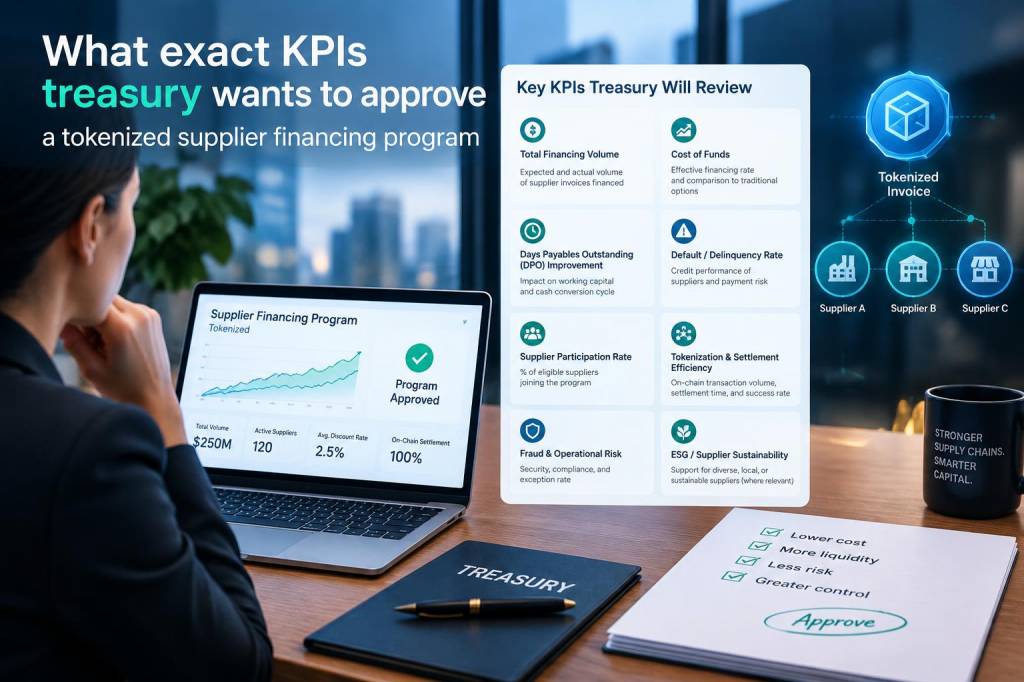
I remember the first time I sat with our treasury team to discuss a tokenized supplier financing program. The room was full of pragmatic questions, cautious optimism, and a long list of "prove it" metrics. If you’re trying to get treasury to sign off on a blockchain-based, tokenized payables solution, you need to speak their language: measurable KPIs that directly map to risk reduction, cost savings, liquidity management, and operational control. Below I share the KPIs I’ve found most effective in getting treasury buy-in, how I frame them, and realistic target thresholds you can propose.
Why treasury cares about KPIs for tokenized supplier finance
Treasury is tasked with protecting corporate liquidity, optimizing cost of capital, and ensuring robust controls. When a new financing vehicle like tokenization enters the picture, treasury wants evidence that it will:
So your KPIs must be focused on quantifiable impacts to those areas. Vanity metrics about transactions on a blockchain won’t cut it. You need measurable improvements in DPO, funding cost, settlement time, risk exposures, and governance adherence.
Core KPI categories treasury expects
I group the KPIs into five pragmatic categories. When I present, I allocate time to show how each metric is measured, which data sources feed it, and the target we aim to hit within 6–12 months.
Table of KPIs, definitions and typical target ranges
| KPI | Definition | Why treasury cares | Typical target (first 6–12 months) |
|---|---|---|---|
| DPO (Days Payable Outstanding) | Average number of days the company takes to pay suppliers. | Directly impacts cash on hand and working capital needs. | Increase by 7–21 days (depending on supplier acceptance and terms). |
| Funding Cost / WACF | Weighted average cost for financing supplier payables via tokenized program. | Represents true cost vs. existing bank or internal funding lines. | Benchmark vs existing bank rate; aim for ≤ existing bank rate + 0–100 bps. |
| Fee Savings per Invoice | Difference in processing and financing fees vs. current solution. | Shows bottom-line benefit and ROI. | £2–£20 per invoice depending on automation and scale. |
| Settlement Time | Time from approval to supplier receipt of funds (or token settlement). | Improves supplier satisfaction and can enable earlier discounts. | Same-day to 48 hours for tokenized settlement vs. standard 3–10 days. |
| Utilization Rate | Percent of eligible invoices or suppliers using the program. | Measures adoption and program relevance. | Target 30–60% of eligible volume in 12 months. |
| Counterparty Credit Exposure | Maximum credit exposure towards financing providers or marketplace. | Treasury must cap concentration and systemic risk. | Set limits by counterparty (e.g., ≤10% of short-term cash or defined credit lines). |
| Transaction Fail Rate / Reconciliation Mismatches | Percent of transactions with settlement errors requiring manual intervention. | Operational risk & cost driver. | <1–2% fail rate; reconciliation mismatch <0.5%. |
| Onboarding Time (supplier) | Average time to onboard a supplier to the tokenized program. | Affects adoption speed and program roll-out cost. | <7–14 days for most suppliers; larger tail for multi-jurisdiction vendors. |
| Smart Contract Audit & Incident Rate | Number of critical vulnerabilities found or incidents post-launch. | Technology/security risk to funds and reputation. | Zero critical incidents; third-party audit completed before go-live. |
| Regulatory / Compliance Findings | Number of issues noted by legal/compliance reviews or regulators. | Direct legal exposure and program viability. | Zero material findings; documented legal opinions and licenses where required. |
How I prove these KPIs: data sources and measurement approach
Treasury expects transparency and traceability. I always show exactly where each KPI comes from:
Combining these sources into a single treasury dashboard is crucial. I usually propose a live Power BI or Tableau dashboard that pulls ERP, bank, and platform data to show DPO lift, cash impact, realized cost savings, and risk metrics in near real-time.
Risk metrics treasury will scrutinize closely
From experience, these are the risk KPIs that trigger the most questions in treasury meetings:
To address these, I propose explicit thresholds, fallbacks (e.g., guaranteed buyback windows, escrowed fiat buffers), and contractual SLAs with fintech partners such as Prime Trust, Fireblocks or major banks integrating token custody. Treasury likes clearly defined “break-glass” scenarios and runbooks.
Demonstrating governance and control
Treasury is less impressed by buzzwords and more convinced by governance artifacts. When I pitch, I present:
These are not optional. Showing a robust control framework — with measurable KPIs like SLA adherence rate, mean time to resolve disputes, and percentage of transactions with full audit trail — goes a long way toward treasury approval.
How to set realistic targets and phased acceptance criteria
I recommend a phased rollout with explicit KPI gates. For example:
Each phase should end with a treasury review against the KPIs and a decision to proceed, pause, or expand. This staged approach gives treasury the control they crave while allowing innovation to prove its value.
If you structure your case around these measurable KPIs, pair them with concrete data sources, and offer staged gates with clear risk mitigations, you’ll significantly increase the chances that treasury will greenlight a tokenized supplier financing program. Treasury doesn’t oppose innovation — it simply demands accountability, transparency, and control. Give them that, and you turn a skeptical treasury into a powerful sponsor of modernization.